The value of object-oriented programming in machine control is not the number of methods, properties or interfaces used. It is the ability to organise machine units, process logic, state handling and diagnostics into software modules with clear, testable boundaries.
OOP should control complexity
TwinCAT 3 provides object-oriented capabilities including function blocks, methods, properties, interfaces and inheritance. Maintainability, however, depends less on how many language features are used and more on whether software boundaries match the responsibilities of the machine and process.
For machines with repeated stations, recipes, operating modes, supervisory interfaces and many reusable mechanisms, a considered object model can reduce duplicated logic and make troubleshooting, expansion and team development more systematic. A small, simple machine may not benefit from unnecessary abstraction.
Separate the software by responsibility
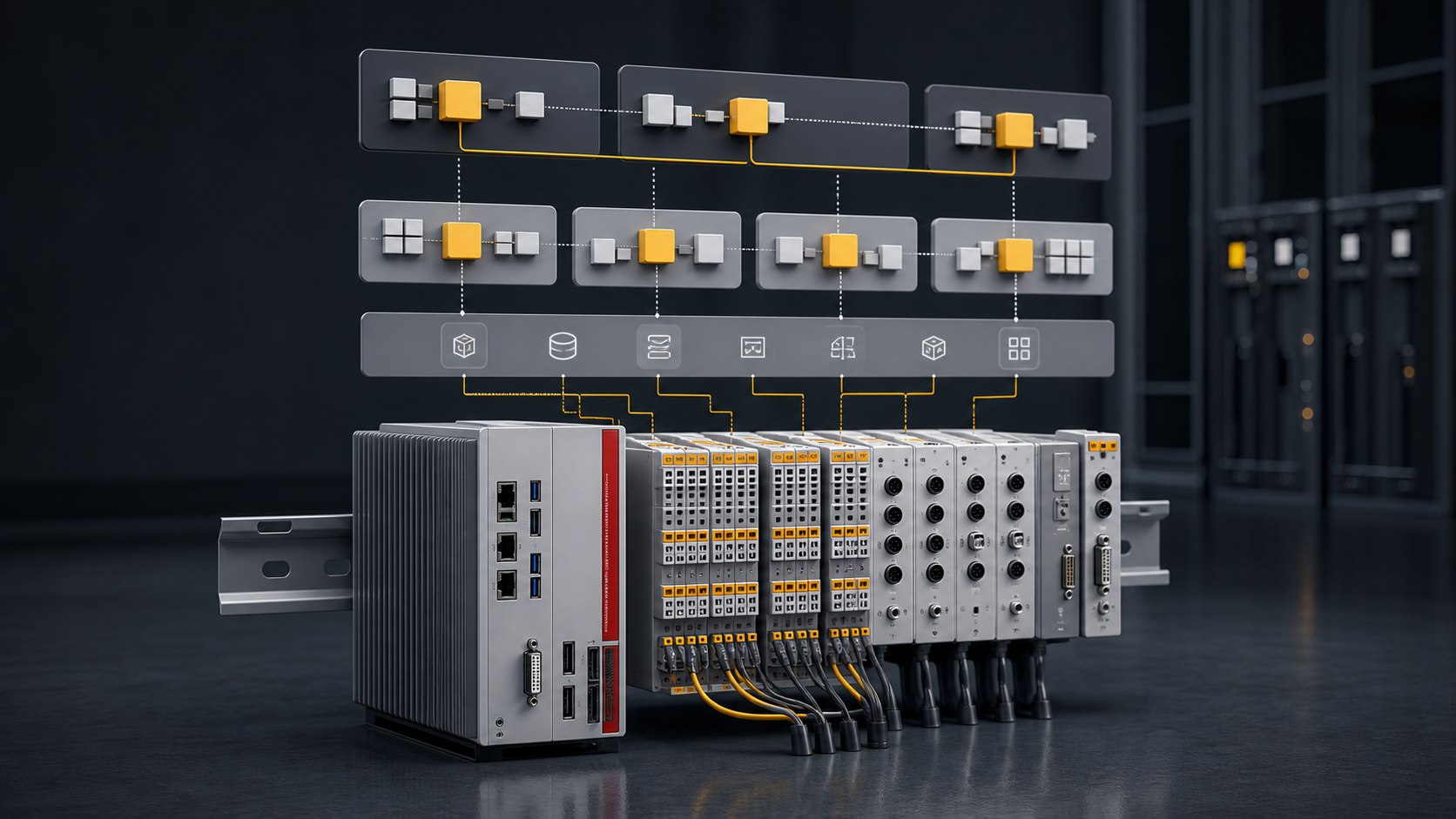
A practical project often separates hardware adaptation, machine units, process coordination and data services. The exact layering should match the size and risk of the machine rather than follow a rigid template.
- Hardware adaptation: wrap raw I/O, drives, sensors and third-party devices so that hardware changes have a limited effect on process logic.
- Machine units: represent cylinders, axes, robot interfaces or stations as independently diagnosable modules.
- Process coordination: manage recipes, sequences, station coordination, cycle time and machine modes without directly manipulating raw signals.
- Data services: provide stable data for HMI, supervisory applications, logging, traceability and external interfaces.
Define object boundaries and data ownership
Each function block should have a clear responsibility, inputs, outputs and internal state. Other modules should interact through commands, states or interfaces. Multiple parts of the program should not modify the same data without an explicit ownership rule, and an HMI should not directly trigger unvalidated internal actions.
Interfaces are useful for stable capabilities such as start, stop, reset, status and diagnostics. Inheritance should be used only when objects share a durable semantic relationship. Composition is often clearer when the goal is simply to reuse a small amount of behaviour.
Standardise states, commands and faults
Machine modules should use consistent definitions for not-initialised, idle, executing, complete, stopped and faulted states. Command acceptance, completion, timeout and recovery conditions should be explicit. Diagnostic messages should identify what occurred, the responsible module and the context needed for investigation.
Safety functions must independently satisfy the machine risk assessment and applicable standards. A normal-control state machine, reset routine or software bypass cannot replace a validated safety control system.
A practical implementation sequence
Begin with one representative machine unit and establish naming, interface and diagnostic conventions. Validate it through simulation, offline tests or controlled equipment conditions before extending the pattern across the machine.
- Map machine modules, action boundaries, shared data and external interfaces.
- Define only the common interfaces or base behaviour that must remain stable.
- Test state transitions, stops, timeouts and abnormal paths as well as the normal cycle.
- Use version control and review temporary commissioning changes before handover.
Avoid abstraction without engineering value
Typical problems include deep inheritance trees, oversized base classes, uncontrolled global data, excessive configuration introduced only for generality, and modules that encapsulate the normal sequence but not stopping and recovery. Complex structures require stronger naming, comments, tests and handover documentation.
Handover checklist
Before handover, confirm that the project builds cleanly, module states and faults can be diagnosed, public interfaces and data dictionaries are documented, backups can be restored, and the TwinCAT version, libraries, target controller and deployment requirements are recorded.
This article presents general engineering methods and does not replace Beckhoff documentation, the project technical specification or the machine risk assessment. Implementation must be verified against the controller model, TwinCAT version, process requirements and actual equipment.