
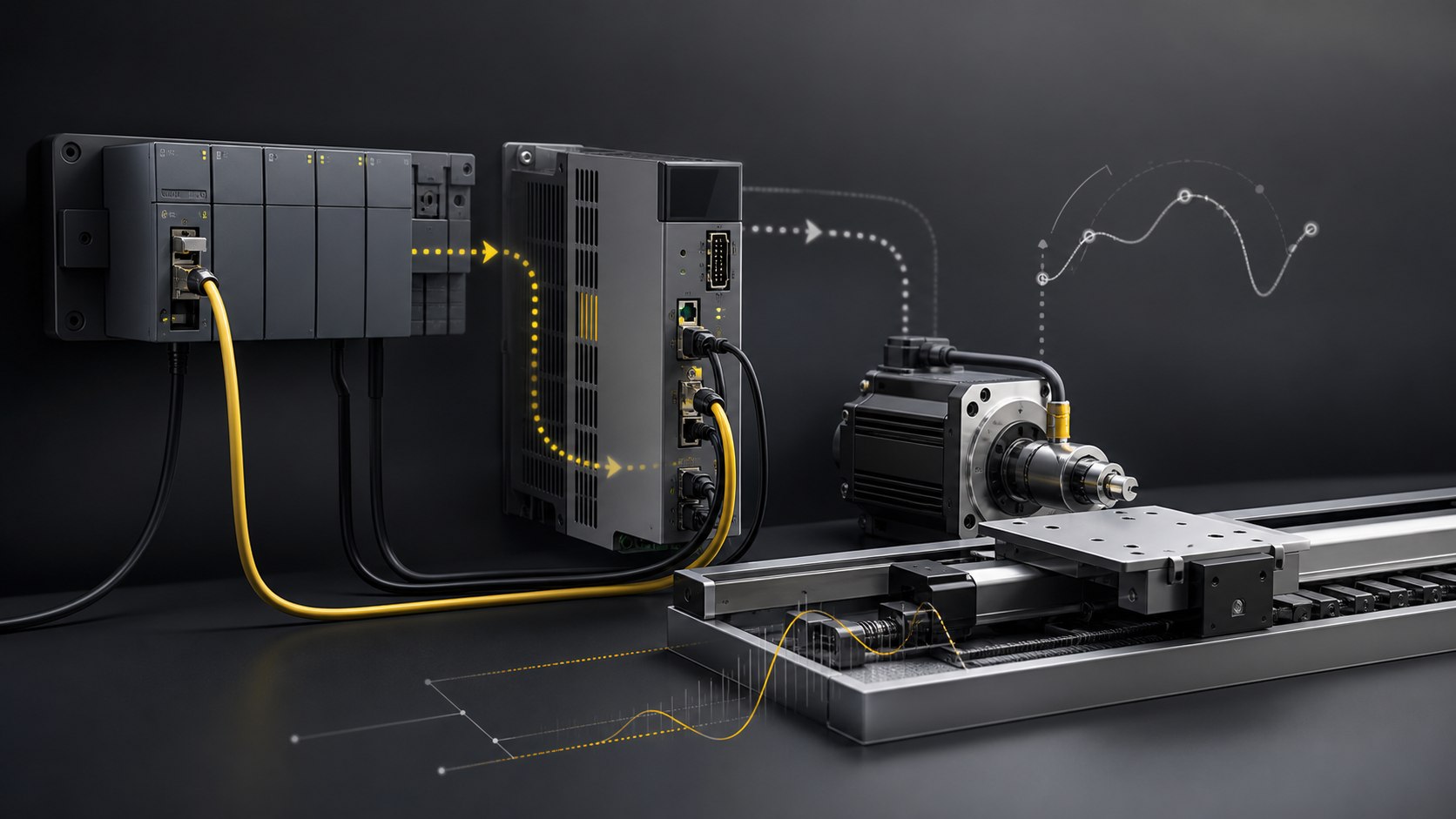
Stable servo motion depends on the combined quality of the mechanical system, component sizing, control interface, safety circuit, parameter baseline and PLC state management. Commissioning should start with requirements and boundaries, not immediate motion.
Define the axis duty first
Before selecting an interface or writing software, define the load inertia, transmission, usable travel, maximum speed, acceleration, positioning accuracy, repeatability, cycle time, brake requirements and mechanical state after power loss. These conditions determine whether the motor, drive, feedback and control cycle are appropriate.
Select the interface for the project
Depending on the specific Inovance PLC and servo families, control may use pulse and direction, analogue references or an industrial network. Pulse control is direct but provides less integrated diagnostics and multi-axis scalability. A fieldbus can centralise commands, status, position and alarms, while introducing requirements for network configuration, device descriptions, synchronisation and compatible versions.
The decision should consider the exact hardware, number of axes, synchronisation needs, customer standards and existing network rather than a single feature.
Prerequisites before motion
Mechanical installation, couplings, lubrication, limits, home sensors, brakes, power, protective earthing and safety functions should be confirmed by the responsible disciplines. Wiring, energised checks and safety validation must follow the model-specific manuals, project drawings, applicable standards and site procedures.
- Confirm that the defined positive direction matches the mechanical design and assess the consequences of reverse motion.
- Confirm that hard limits, software limits, emergency stops and guards remain effective during commissioning.
- Retain the original parameter set and record every controlled change.
- Begin motion under controlled conditions with a low-risk load and conservative speed and acceleration.
Commission the axis in stages
Verify basic PLC-to-drive status exchange before checking enable, direction, feedback, jogging, homing, positioning, motion profiles and stopping behaviour. Increase the operating range only after each stage is confirmed, while observing following error, current, vibration, temperature and brake action.
Manage the complete lifecycle in the PLC
An axis module should manage initialisation, enable, homing, motion, stop, fault, reset and restart conditions rather than wrapping only absolute or relative moves. Commands need busy, complete, error and timeout feedback to prevent repeated triggers or competing requests.
Recovery after power-up, emergency stop, lost position, communication interruption or a drive alarm must follow the process requirements and risk assessment. Unreviewed automatic recovery can create unexpected motion.
Optimise only after the mechanism is stable
Poor positioning is not always solved by increasing gain. Backlash, structural stiffness, changing loads, alignment, trajectory planning and sampling time all affect performance. Mechanical and sizing issues should be addressed first, followed by controlled parameter adjustment within manufacturer guidance and with recorded test results.
Acceptance and handover
Acceptance should cover homing consistency, accuracy, cycle time, continuous operation, limit protection, stopping, alarm recovery and restart after power interruption. Handover records should include software backups, drive parameters, versions, axis-direction conventions, commissioning results and necessary maintenance notes.
This article presents general engineering considerations and does not provide model-specific terminal wiring, parameter values or safety-circuit design. Qualified personnel must verify the exact Inovance hardware, manuals, mechanical risks and site safety requirements before implementation.