
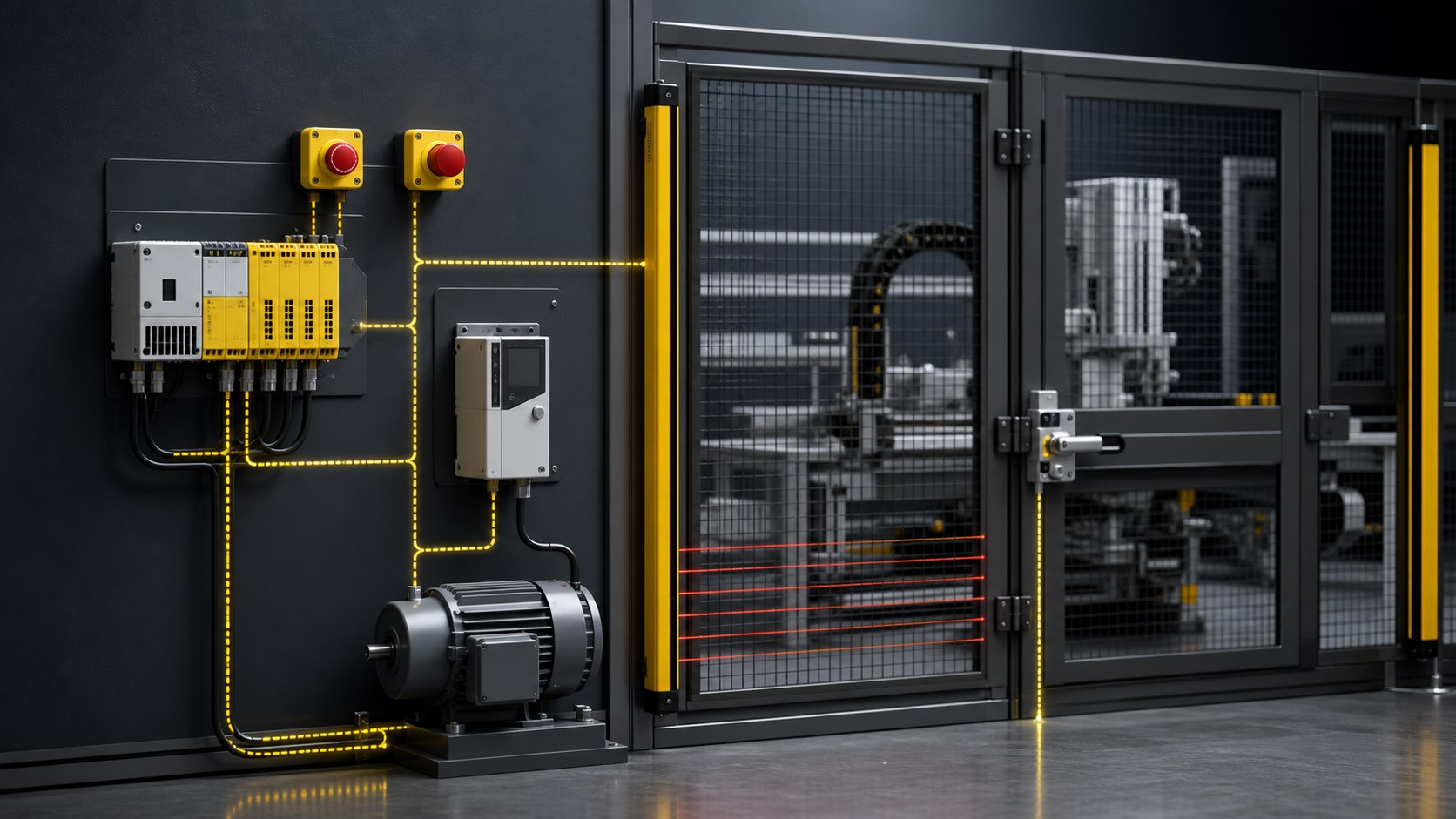
A safety PLC and safety network are implementation tools, not a complete safety argument. A dependable machine-safety system requires a lifecycle covering risk assessment, safety requirements, architecture, software review, validation and controlled change.
Begin with the risk assessment
Before selecting GuardLogix, Compact GuardLogix, safety I/O or a CIP Safety network, identify hazards across the machine lifecycle, access to danger zones, foreseeable failures, exposure and avoidance. Required risk-reduction measures must follow the applicable regulations and standards. A controller model cannot replace this assessment.
Create verifiable safety requirements
Each safety function needs an inspectable definition covering the initiating device, controlled hazard, safe state, reset method, restart conditions, response time and target performance or integrity requirement. Mechanical, electrical, fluid-power and process disciplines should review these requirements together.
- Identify which hazards are controlled by emergency stops, guards, light curtains or two-hand controls.
- Define whether the safe state removes energy, holds position or permits a controlled safe speed.
- Confirm that the reset location provides suitable visibility and that reset does not directly initiate motion.
- Define the state required after diagnostics, communication loss or device replacement.
Keep standard and safety control boundaries clear
Standard control may provide process requests or status to the safety application, but standard logic must not bypass safety inputs, force safety outputs or weaken the defined reaction. Interfaces between safety tasks, standard tasks, shared data and network status should be minimal and directional.
Any commissioning suspension or controlled safety mode must be part of the risk assessment and formal design, with appropriate authority, indication, limits and restoration conditions. Temporary jumpers, undocumented forces and retained commissioning bypasses are not an acceptable delivered state.
Design software that can be reviewed
Use consistent naming, zone definitions, reset principles and fault handling. Avoid deeply nested or indirect conditions that are difficult to trace. Each safety output should be traceable to a requirement, including how device feedback, network status and diagnostics affect the decision.
Validate faults and boundary conditions
Validation is more than checking that an emergency stop halts the machine. It should cover every safety function, reset behaviour, prevention of unexpected restart, diagnostics, response time and relevant fault reactions. Test method, expected result, observed result, responsible person and date should be recorded.
Validation must be performed by competent personnel who understand the machine hazards. Where applicable, design and validation may need to address ISO 12100, ISO 13849-1, IEC 62061, IEC 60204-1 and local regulations; the responsible project organisation must determine the exact requirements.
Manage signatures, backups and change
Handover should preserve the validated software, controller and tool versions, network and device configuration, safety signature or equivalent version identity, validation records and recovery information. A change to safety logic, hardware, network, mechanical design or process must be assessed for its effect on the previous validation and the required revalidation scope.
Maintenance remains part of the safety lifecycle
After production starts, safety devices require inspection, functional testing, spare-parts control and personnel training according to risk and operating conditions. Repeated trips should trigger root-cause investigation, not broader bypassing or reduced protective conditions.
Machine safety is a high-responsibility engineering activity. This article provides general lifecycle and design considerations only; it is not a safety design, compliance conclusion or validation report for any specific machine. Competent responsible persons must apply the risk assessment, official documentation, relevant standards and local regulations.